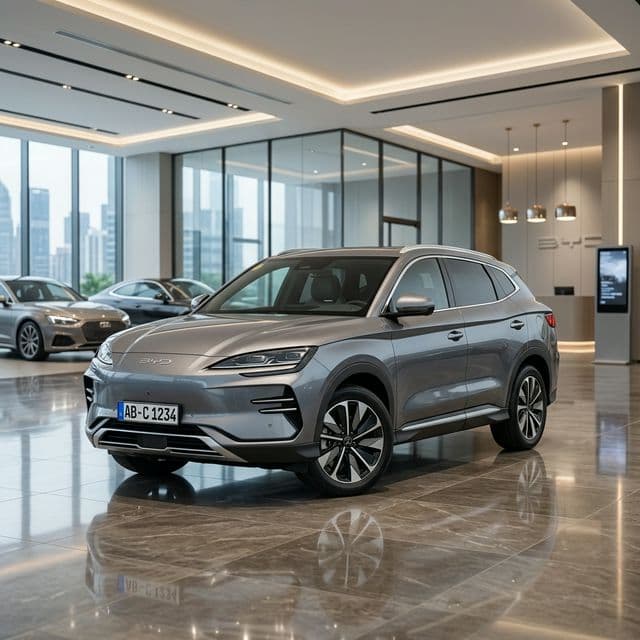
EU PHEV CVD Risk: China EV Import Pricing Impact
EU PHEV CVD risk may erase China EV import margins. Check EU scope, pricing exposure, retroactive risk, and quote actions for buyers.
Decision-level conclusion, verified 25 June 2026: EU PHEV CVD risk has moved from background tariff noise to a live quote-risk item for China-built plug-in hybrid vehicles. Reuters reported on 19 June 2026, citing Handelsblatt, that the European Commission is preparing countervailing duties on Chinese hybrid cars, while the Commission declined to comment. Until an implementing act appears in the Official Journal, treat this as a high-probability policy scenario, not an active duty line.
This assessment is for vehicle importers, distributors, dealer groups, fleet buyers, customs brokers, and cross-border sourcing teams pricing China-built PHEVs into the European Union. It matters because a quote built on only the standard 10% passenger-car import duty can become loss-making if PHEV duties are aligned with the existing China-origin BEV countervailing-duty bands.
Need a customer-ready quote gate now? Run the China EV Export Checklist, model the current BEV baseline on the car import tariffs decision page, and pressure-test the shipping plan with RoRo vs Container Shipping before issuing fixed landed-cost commitments.
Published: 25 June 2026. Last verified: 25 June 2026 (UTC). Scope: China-origin PHEVs shipped to the EU customs territory. Out of scope: UK, Australia, Middle East, and Latin America local tariff rules; consumer retail buying advice; non-China origin programs; legal advice replacing customs counsel.
Why This Matters for Import Pricing
The current confirmed legal baseline is narrow: EU definitive countervailing duties apply to new China-origin battery electric vehicles (BEVs) under Implementing Regulation (EU) 2024/2754. The published definitive rates include Tesla 7.8%, BYD 17.0%, Geely 18.8%, cooperating companies 20.7%, and SAIC / non-cooperating companies 35.3%, on top of the ordinary customs duty.
Chinese PHEVs were outside that BEV scope, so importers have been able to price them around the standard 10% customs-duty assumption. The June 2026 risk is that the same subsidy logic could be applied to China-origin PHEVs, removing the margin buffer that made PHEVs attractive after the BEV measure.
What Changed in June 2026
The change is not that PHEV duties are already collectable. The change is that a reported Commission preparation path makes the old "PHEVs are safe because they are not BEVs" pricing assumption too weak for fixed customer quotes.
| Date | Evidence | What changed | Affected lane | Buyer decision impact |
|---|---|---|---|---|
| 30 Oct 2024 | Implementing Regulation (EU) 2024/2754 | Definitive CVD became applicable to China-origin BEVs for five years. | EU imports of covered BEVs | Existing duty bands provide the nearest scenario benchmark for PHEV risk. |
| 19 Jun 2026 | Reuters report citing Handelsblatt | Commission preparations for countervailing duties on Chinese hybrid cars were reported; Commission declined to comment. | EU-bound China PHEVs | Do not quote long-term fixed prices on only a 10% duty assumption. |
| 25 Jun 2026 | EUR-Lex / Official Journal check | No specific PHEV implementing regulation was identified in the reviewed public sources. | EU-bound China PHEVs | Keep the file marked as scenario risk until an official act is published. |
Current vs Scenario Duty Stack
Use this table as a pricing stress test, not as a customs declaration.
| Vehicle category | Current confirmed EU duty treatment | Scenario if PHEV CVD mirrors BEV bands | Pricing action |
|---|---|---|---|
| China-origin BEV passenger cars in Regulation 2024/2754 scope | Standard customs duty plus definitive CVD bands from 7.8% to 35.3% | Already active for covered BEVs | Use the producer-specific band and required invoice proof before quoting. |
| China-origin PHEVs | Standard customs duty baseline; no PHEV CVD act found in this review | Scenario range of 17.8% to 45.3% total before VAT if BEV-like bands are copied | Hold contingency margin, duty pass-through clauses, and a reprice trigger. |
| ICE or non-plug-in hybrid vehicles | Standard customs-duty treatment unless another measure applies | Not covered by this PHEV scenario | Do not transfer PHEV or BEV assumptions without tariff-classification review. |
Boundary: Exact PHEV rates, legal effective date, product scope, producer list, and whether any retroactive collection path is triggered remain unconfirmed until an official EU act is published.
Buyer Action Checklist
Use this checklist before committing a fixed DDP, CIF-plus-duty, fleet, or dealer price.
- Inventory already at an EU port: confirm customs status, entry date, importer of record, HS/TARIC code path, and whether the vehicle has entered free circulation.
- Inventory on the water: model both the current 10% baseline and a BEV-band scenario. Do not release a customer price without a duty-adjustment clause.
- Factory or China-yard stock: renegotiate allocation windows and cancellation terms before the EU position is legally final.
- Distributor and fleet contracts: add explicit tax, anti-subsidy duty, customs registration, and retroactive-duty allocation language.
- Supplier claims of local assembly: require origin certificates and value-add evidence. SKD/CKD routing does not automatically remove EU origin or anti-circumvention risk.
Retroactive-Duty Exposure
EU anti-subsidy rules allow retroactive collection only under defined conditions. The practical buyer risk is not "every car imported today will be retroactively billed." The risk is that registered imports can become exposed if the legal prerequisites are met and later measures are imposed.
| Risk vector | Trigger condition to watch | Financial exposure | Minimum buyer control |
|---|---|---|---|
| Retroactive collection | EU customs registration of imports before provisional or definitive collection | Potential duty liability on inventory already sold or delivered | Put retroactive-tax allocation into contracts and keep customs-entry evidence. |
| Producer-specific banding | PHEV measure copies BEV-style producer bands | Margin depends on OEM group and cooperation status | Quote by producer group, not by generic "China PHEV" label. |
| Origin workaround audit | OEM routes through Turkey, Morocco, or EU assembly with weak local value-add | Duty relief claim can fail or trigger anti-circumvention review | Require origin, assembly, battery, and invoice documentation before volume commitment. |
Markets Outside the EU
The June 2026 PHEV CVD story is an EU customs-risk item. Do not automatically copy it into non-EU destination quotes.
| Region | What to do now | Why |
|---|---|---|
| United Kingdom | Keep a separate UK tariff and type-approval file. | This review found no synchronized UK PHEV CVD measure. |
| Australia | Keep ADR, RAV entry, motive-power field, and import-approval checks separate from EU CVD modeling. | Australian admissibility and evidence gates are not EU tariff measures. |
| Middle East | Treat this mainly as a sourcing-price and allocation risk unless the deal is EU-routed. | Gulf customs and homologation paths are destination-specific. |
| Latin America | Recheck each country tariff line, valuation rule, and homologation path. | EU anti-subsidy actions do not create local duty rates. |
Risks, Limits, and Evidence Gaps
- No PHEV implementing regulation found in this review: The article is a risk assessment based on reported preparations and the published BEV precedent.
- Exact PHEV rate is unknown: The 7.8% to 35.3% range is a BEV benchmark, not a published PHEV schedule.
- Retroactivity is conditional: It depends on the EU registration and collection path used in the eventual procedure.
- UK and other destination markets are excluded: The risk changes EU pricing assumptions, but it does not rewrite UK, Australia, Middle East, or Latin America import rules.
- Supplier workaround claims need evidence: Local assembly, SKD, CKD, or invoice restructuring should be reviewed by customs counsel before quote release.
FAQ
Are Chinese PHEVs already subject to the EU 35.3% CVD?
No. As of 25 June 2026, this review did not identify a published EU implementing regulation that applies a China-origin PHEV CVD. The confirmed CVD schedule applies to covered BEVs, while PHEVs are a reported preparation risk.
Why should buyers act before a final PHEV regulation is published?
Because fixed quotes, fleet tenders, and dealer allocations often lock before customs entry. A contract that assumes only the standard 10% duty can lose margin if new duties are adopted before clearance or if retroactive registration conditions apply.
Should I cancel China PHEV orders headed to the EU?
Not automatically. First separate inventory already in EU customs control from inventory still at factory or on the water, then reprice with a BEV-band stress case, written duty pass-through, and supplier cancellation or reallocation options.
Does this EU risk apply to the UK, Australia, Middle East, or Latin America?
No, not directly. Those markets need separate tariff, homologation, and import-permit checks. The EU risk can still affect supplier pricing and allocation, but it does not create a local duty rate outside the EU.
Related China EV Export Pages
- China EV Export Checklist Before You Request a Quote
- China car import tariffs tool and decision page
- RoRo vs Container Shipping for Chinese EV Exports
- China EV Export Market Update (2026-W25): UK eCoC, Australia motive-power gate, Hormuz, and Panama
- Talk to our sourcing and import team
Sources
- Reuters: EU prepares tariffs on Chinese plug-in hybrids, Handelsblatt reports - reported 19 June 2026 and states the Commission declined to comment.
- European Commission Access2Markets: EU Commission imposes countervailing duties on imports of BEVs from China - confirms definitive BEV CVD under Implementing Regulation (EU) 2024/2754.
- EUR-Lex: Commission Implementing Regulation (EU) 2024/2754 - official BEV CVD legal text and producer-specific duty schedule.
- EUR-Lex: Regulation (EU) 2016/1037 on protection against subsidised imports - basic EU anti-subsidy regulation for procedural context.
- Eurostat: Trade and production of hybrid and electric cars - background on EU trade in electric, plug-in hybrid, and hybrid cars.
Author

Categories
More Posts
China EV Export Market Update (2026-W15): Gulf Lane Shock, UK eCoC Cutover, Panama Booking Discipline
Decision-focused update for importers: Middle East lane disruption, UK eCoC timing, Panama booking rule changes, and EU tariff baseline checks.
China EV Export Checklist Before You Request a Quote
The minimum information serious buyers should prepare before asking for an FOB or CIF quote on a Chinese EV.
China EV Export Market Update (2026-W27): EU-China Tariff Consultations, July 1 Process Gates, and Spare Parts Customs
China EV export update (2026-W27): EU-China TIC, AU ROVER motive-power, EU €3 parcel duty, UK eCoC Nov 29 shift, and Maersk U37.