2024 MG Comet EV fit checker & buying guide

Check the trim and charging proof before buying.

Snapshot: June 12, 2026. Historical prices.

5 required inputsProof check
MG Comet EV fit checker

Set destination rules first. The same listing behaves very differently in India city-use, export-flex, strict homologation, or U.S. boundary workflows.

Choose who owns the risk. Dealer, retail, and fleet roles tolerate evidence gaps differently.

Clarify the goal so the tool can separate low-cost preference from proof-first, uptime, or resale constraints (for example 7.4kW vs 3.3kW charging assumptions).

Proof quality changes the decision more than marketing language. Full pack means VIN, charging power evidence, and trim-level proof are present.

Pick the closest variant signal to avoid mixing launch-year labels with unknown trim claims.

Your next step starts here

Choose five inputs for an evidence checklist and next step.

2024 variant evidence

Which 2024 MG Comet EV listing are you checking?

Use this dated trim ladder to separate AC fast-charging hardware from a seller’s year tag. FC is not a DC rapid-charging claim.

MG India release, March 12, 2024. Historical ex-showroom prices in INR; not current, on-road, used-stock, or export prices.
TrimRelease priceCharging signal
Executive₹6,98,800Non-FC
Excite₹7,88,000Non-FC
Excite FC₹8,23,800AC fast charging
Exclusive₹8,78,000Non-FC
Exclusive FC₹9,13,800AC fast charging
From listing to a verified quote

Match the VIN and trim sheet, then check the charging port, supported AC power, and a recent session record. Confirm site power before applying the published charging windows.

If identity or charging proof is missing, pause the quote and request those documents. A 2024 registration or a later cosmetic package does not establish FC hardware.

Open the evidence checklist

Report summary

Core conclusions and decision numbers

Read this section after running the tool to confirm whether your result is supported by evidence or blocked by boundaries.

2024 FC expansion
Excite FC ₹8.23L and Exclusive FC ₹9.13L

MG Motor India announced Comet EV fast-charging variants on March 12, 2024, with a five-trim price ladder from Executive to Exclusive FC. That makes 2024 mg comet ev a variant-and-charging verification query, not a separate model entity.

Source: MG Motor India EV portfolio release (March 12, 2024; rechecked June 12, 2026)

Dated price comparison
2024 FC ₹8.23/₹9.13L vs June 2026 snapshot up to ₹9.99L

The June 12, 2026 MG product-page snapshot showed variant start prices such as Executive ₹7.62L, Excite ₹8.72L, and Exclusive FC ₹9.99L, so buyers should not reuse March 2024 price anchors for current quote approval.

Source: MG Comet EV product page (accessed June 12, 2026)

Launch-trim timeline
2023 launch: Pace ₹7.98L, Play ₹9.28L, Plush ₹9.98L

MG's May 5, 2023 launch release publishes a distinct Plush launch price, so plush-tagged listings should be validated against launch-year trim evidence instead of current promo headlines.

Source: MG Comet EV launch release PDF (May 5, 2023; accessed April 28, 2026)

Trim-specific battery capacity
Brochure: 17.3 kWh; 17.4 kWh for FC variants

The linked brochure rechecked October 22, 2026 lists 17.3 kWh and identifies 17.4 kWh for FC variants. Confirm the trim and dated VIN-linked spec rather than treating both capacities as interchangeable.

Source: MG Comet EV brochure, technical specifications p.18 (rechecked October 22, 2026)

Charging dependency
AC split: 7h @3.3kW vs 3.5h @7.4kW; FC 10-80%: about 2.5h

Official assets show materially different charging windows by power path and variant labeling, and brochure notes that features/specs are not standard across all variants.

Source: MG track-and-trace page + MG Comet EV brochure PDF (accessed April 28, 2026)

Price communication split
₹9.98L Plush (2023) -> ₹8.23/₹9.13L FC (2024) -> BaaS ₹3.1/₹3.20 per km

Official launch release, EV portfolio update, brochure, homepage/product surfaces use different pricing modes (ex-showroom, FC trims, BaaS per-km), and the June 2026 snapshot showed both ₹3.1/km and ₹3.20/km tokens.

Source: MG launch release + EV portfolio release + brochure + product/homepage surfaces (rechecked June 12, 2026)

Safety-rating evidence gap
No official public Bharat NCAP or Global NCAP Comet EV result confirmed

Bharat NCAP describes a voluntary, consumer-facing rating program and Global NCAP publishes official crash-test results, but this review did not find a stable public MG Comet EV rating entry on those official sources.

Source: Bharat NCAP + Global NCAP public sites (checked June 12, 2026)

Regulatory route threshold
NHTSA <25-year gate + vehicle-specific EPA declaration

For a nonconforming vehicle under 25 years old, verify NHTSA eligibility and a Registered Importer route. Electric road vehicles also need EPA import declarations; EPA certification or a valid exemption must be checked for this vehicle. General engine-age guidance is not a Comet EV approval.

Source: NHTSA import FAQ + EPA import guidance/forms pages (accessed April 28, 2026)

Class-adjacent competitor split
Wuling 17.3/26.7 kWh vs Tiago.ev 19.2/24 kWh

Official competitor materials show larger battery and charging-profile spread, reinforcing that micro-EV comparison needs cycle and charger-context matching, not headline-only range.

Source: Wuling official battery page + Tata Motors Tiago.ev launch release

Verify the 2024 trim before using any FC charging claim
Excite FC and Exclusive FC are the 2024 AC fast-charging variants

The March 2024 lineup distinguishes FC from non-FC trims. A listing year or cosmetic package does not prove charging hardware. Request the VIN-linked trim sheet and charging evidence.

Source: MG EV portfolio release PDF (March 12, 2024; rechecked October 22, 2026)

Range confidence depends on test-cycle interpretation, not headline alone
230 km headline with ARAI basis documented in brochure

The brochure states ARAI standard test conditions and notes actual results can differ. Product/spec pages do not always show the cycle basis inline, so route-specific conversion is mandatory.

Source: MG Comet EV brochure PDF + MG track-and-trace/spec pages (accessed April 28, 2026)

Charging-time promises are conditional on confirmed site power
0-100% 7h (3.3kW) vs 3.5h (7.4kW), with FC 10-80% around 2.5h

Treat 7.4 kW and FC timing as conditional evidence tied to variant and infrastructure. If only 3.3 kW infrastructure is available, planning assumptions must be recalculated before fleet commitments.

Source: MG track-and-trace/spec pages + MG brochure (accessed April 28, 2026)

Pricing comparisons must normalize sticker, per-km, and trim-level deltas
2023 Plush ₹9.98L; 2024 FC ₹8.23/₹9.13L; June 2026 snapshot from ₹7.62L; BaaS tokens ₹3.1/₹3.20 per km

Official sources publish launch ex-showroom prices, 2024 FC variant prices, June 2026 variant-card snapshots, and BaaS logic with private-registration and finance-partner conditions. Without dated variant locks and annual-km scenarios, total-cost decisions can invert.

Source: MG launch release + EV portfolio release + brochure + product page (rechecked June 12, 2026)

Safety claims must separate features from crash-test rating
Feature list is not an NCAP star rating

MG public pages list safety equipment by variant, while Bharat NCAP/Global NCAP star-rating evidence was not found in official public result pages during the June 12, 2026 evidence review. Treat NCAP star claims as pending confirmation until an official result is published.

Source: MG product page + Bharat NCAP + Global NCAP (checked June 12, 2026)

U.S. import cases remain compliance-first and model-specific
NHTSA eligibility + RI + HS-7, plus EPA Form 3520-1

General guidance does not equal model approval. A 2023 model-year vehicle is far below NHTSA's 25-year lane, so it requires nonconforming-vehicle workflow and EPA pathway proof before any shipment commitment.

Source: NHTSA FAQ appendix + EPA import guidance/forms pages (accessed April 28, 2026)

Comparison layer

Comet EV versus adjacent compact EV options

Comparison values are shown with context notes so buyers can avoid decorative table reading and make practical route decisions.

DimensionMG Comet EVWuling Air evTata Tiago.evDecision reading
Battery capacity (kWh)17.3 kWh; 17.4 kWh for FC variants (brochure p.18, rechecked October 22, 2026)17.3 or 26.7 kWh19.2 or 24 kWhComet EV remains entry-capacity, but cross-source normalization is needed before comparing with larger-pack variants.
Claimed range and cycle disclosure230 km; brochure states ARAI basis, web page often omits cycle200 km or 300 km (official variant claim)250 km or 315 km MIDC (official claim)Do not compare headline range without cycle disclosure quality and variant context.
Charging profile (published examples)AC Type 2; 0-100% about 7h (3.3kW) or 3.5h (7.4kW), FC 10-80% about 2.5h on FC path2200 VA / 6600 VA examples: 8.5h to 4.5h by variantAC 3.3/7.2 kW and DC fast-charge route; 10-80% in 57 minIf uptime is primary, validate charger power and FC availability per variant before price comparison.
Urban maneuverability4.2 m turning radius, 2,974 mm lengthUrban compact EV framingLarger hatchback footprint classComet EV keeps a strong parking-and-turning advantage for dense city loops.
Pricing communication pattern2023 Plush ₹9.98L launch anchor, 2024 FC prices ₹8.23/₹9.13L, June 2026 snapshot up to Exclusive FC ₹9.99L, plus BaaS expressions (₹3.1 or ₹3.20 per km by source/date)Official battery page emphasizes variant spec, not transaction pricingLaunch communication ties price to battery/variant splitNormalize by pricing mode and date; sticker-only comparison can invert the real decision.
Warranty signal (official mentions)HV battery 8y/120k km; private-registration and ownership conditions apply. 12V/tyre 1y; infotainment 3y (brochure pp.7,14)Power battery/motor/controller 8y or 120k kmBattery and motor warranty 8y or 160k kmWarranty terms are not equivalent; validate transferability, ownership scope, and commercial-use constraints before deal lock.
Public crash-test ratingN/A: no official public Bharat NCAP or Global NCAP star result confirmed in this reviewN/A in this comparison set; verify local NCAP source before quotingN/A here; compare only with official rating pages if neededFeature lists do not replace crash-test ratings. Mark safety rating as unknown unless the source is official and current.
Best-fit use caseDense-city short loop and predictable daily kmCity EV with broader variant splitBroader mixed-use micro-to-subcompact EV laneChoose by duty cycle first, not by isolated headline numbers.
Range context map
Charging decision split

Evidence and method

Known values, unknown boundaries, and reproducible workflow

Every key point shows known versus unknown status so buyers can prioritize the minimum next step instead of guessing.
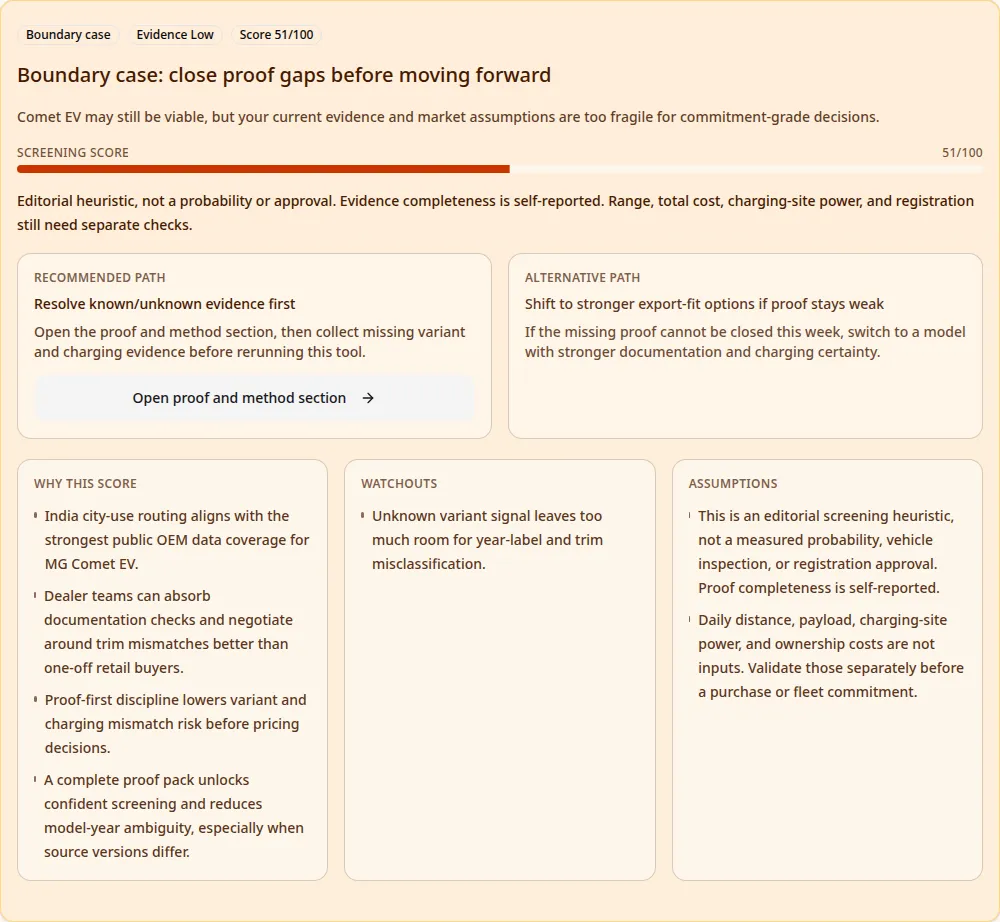
2024 MG Comet EV checker showing a boundary result when the vehicle variant is unknown
Reproduced October 22, 2026: India city-use, dealer, proof-first, full proof pack, unknown variant. The checker caps the score at 51 and requests variant evidence. This is a software run, not a vehicle test, customer endorsement, or import approval.
SignalKnownUnknown / boundaryBuyer action
Battery and range publication driftThe brochure rechecked October 22, 2026 lists 17.3 kWh, 17.4 kWh for FC variants, and 230 km under ARAI test conditions. Its price table is effective July 1, 2026; it is not a March 2024 trim specification.No vehicle-specific usable capacity or WLTP/EPA-equivalent range is established by this brochure. Confirm the exact trim with the seller.Track source version/date in your quote pack and convert range using your own route profile before commitment.
Charging behaviorType 2 charging plus estimated 3.3 kW (0-100%: 7h; 0-80%: 5.5h), 7.4 kW (0-100%: 3.5h; 0-80%: 2.8h), and 7.4 kW 10-80% about 2.5h are published in official MG assets. March 2024 release ties fast-charging launch to Excite FC and Exclusive FC.Brochure notes that features/specifications are not standard across all variants and destination infrastructure quality is not guaranteed by public pages.Treat 7.4 kW and FC timing as conditional evidence. Verify site power, charger compatibility, and multi-session logs before promising uptime.
Warranty boundaryBrochure pp.7 and 14 list 8 years/120,000 km for the HV battery with private-registration and ownership conditions; 12V battery/tyres have 1-year and infotainment 3-year references. Obtain the actual vehicle warranty contract.Second-owner transferability, export-country enforceability, and commercial-use exclusions are not fully standardized in public summaries.Request full warranty booklet, transfer clauses, and jurisdiction-specific exclusions in writing before quote lock.
Dimension fitLength 2,974 mm, width 1,505 mm, height 1,640 mm, wheelbase 2,010 mm, turning radius 4.2 m are published.Cargo and rear-seat usage suitability for specific fleet tasks is not standardized by OEM data.Run scenario checks for passenger count, cargo shape, and route profile before commitment.
Price structure2023 launch release lists Pace/Play/Plush at ₹7.98/₹9.28/₹9.98 Lakh; the 12 Mar 2024 release lists Executive/Excite/Excite FC/Exclusive/Exclusive FC at ₹6.98/₹7.88/₹8.23/₹8.78/₹9.13 Lakh; the June 12, 2026 product-page snapshot showed higher variant start prices including Executive ₹7.62 Lakh and Exclusive FC ₹9.99 Lakh; the linked brochure rechecked October 22, 2026 shows BaaS from ₹4.99 Lakh + ₹3.2/km with private-registration and finance-partner conditions.No single official page publishes a normalized 3-5 year total-cost conversion across ex-showroom and BaaS modes, and public surfaces can show mixed per-km tokens.Lock quote version by variant, date, and pricing mode (outright vs BaaS), then build low/mid/high annual-km scenarios before comparing competitors.
Variant integrity in 2023-tagged inventoryLaunch-year and later variant language coexist; MG 2024 release explicitly separates Executive/Excite/Excite FC/Exclusive/Exclusive FC positioning and prices.Seller labels do not always map cleanly to OEM variant definitions without document evidence.Require VIN-linked trim proof, FC/non-FC confirmation, and photo evidence aligned to the claimed year/trim.
Safety rating versus safety featuresMG product pages publish variant-level safety equipment, and the March 12, 2024 release says the FC variants include items such as Electronic Stability Control, Electronic Parking Brake, Rear Disc Brake, and Hill-Hold Control.Pending confirmation: this review did not find a reliable public Bharat NCAP or Global NCAP star-rating entry for MG Comet EV on official sources.Do not quote an NCAP star score unless an official result page is supplied. Separate feature verification from crash-test-rating claims in buyer documents.
Cross-market homologationNonconforming vehicles under 25 years need a vehicle-specific NHTSA eligibility and RI route. EPA also requires electric road vehicles to be declared using Form 3520-1 under the applicable certification or exemption code.Public guidance does not automatically confirm a direct on-road route for every Comet EV model-year/variant combination.Move strict markets into compliance-first workflow before freight, payment, or dealer quote lock.
Method flow
Proof quality gauge
Step 1
Step 1: Execute tool-first screening

Collect five mandatory inputs (market, buyer role, priority, proof level, variant signal) and generate a status score before deep reading.

Step 2
Step 2: Validate core numbers against primary sources

Use OEM and regulatory pages only for range, battery, charging, pricing, warranty, and compliance boundaries. Mark unknowns explicitly.

Step 3
Step 3: Reconcile cross-source drift before modeling

Record source version and trim notes: the rechecked brochure distinguishes 17.4 kWh for FC variants. Do not project a later brochure onto an older VIN.

Step 4
Step 4: Split known vs unknown evidence

Separate published facts from missing proof so buyers know exactly what remains uncertain and what can be acted on immediately.

Step 5
Step 5: Stress-test with scenario and risk matrix

Run best-fit and failure scenarios to prevent misuse of launch-year aliases and to expose compliance-sensitive routes early.

Step 6
Step 6: Map every result to a next action

Each status output links to a concrete next step: proceed, conditionally proceed, boundary review, or redirect workflow.

BaaS per-km sensitivity
This table converts the dated ₹3.1/km and ₹3.20/km examples into annual and three-year line items before financing, insurance, charging tariff, registration, duties, and dealer quote changes.
Annual distanceAt ₹3.1/kmAt ₹3.20/kmDecision use
5,000 km/year₹15,500/year; ₹46,500 over 3 years₹16,000/year; ₹48,000 over 3 yearsLow private-use mileage keeps per-km battery charges smaller, but contract scope and finance conditions still decide whether BaaS is usable.
10,000 km/year₹31,000/year; ₹93,000 over 3 years₹32,000/year; ₹96,000 over 3 yearsUse this as a normal city-commute sensitivity case before comparing BaaS with outright battery-inclusive pricing.
15,000 km/year₹46,500/year; ₹139,500 over 3 years₹48,000/year; ₹144,000 over 3 yearsHigher usage makes the per-km line item visible enough to change total-cost ranking against alternatives.
20,000 km/year₹62,000/year; ₹186,000 over 3 years₹64,000/year; ₹192,000 over 3 yearsFleet-like mileage needs a contract-level approval path; do not approve on low sticker price alone.

Risk and boundaries

Misuse risk, cost risk, and scenario mismatch controls

Blocker and high-impact risks are made explicit with mitigation actions so the page can be used operationally, not just informationally.

RiskImpactProbabilityTriggerMitigation
Variant mismatch hidden behind 2023 keyword labelingHighHighListing title and option sheet describe different trims.Require VIN-linked trim documentation and photo evidence before quote confirmation.
Range misuse across testing contextsHighMediumBuyer treats 230 km headline as universal and ignores the brochure ARAI test-condition caveat.Convert to route-specific energy expectation with conservative seasonal adjustment and explicit cycle-normalization notes.
Charging-speed assumption errorMediumHighBuyer quotes 3.5h charging outcome without proving 7.4 kW infrastructure and variant support.Collect connector photos, charger-power proof, and session logs before shipment booking.
Trim-level safety/feature mismatchHighMediumListing assumes FC/ESC-related features while VIN evidence does not confirm Excite FC or Exclusive FC trim.Require VIN-linked trim sheet and variant photo proof before contract signature.
Unverified NCAP star claimHighMediumSeller or broker presents safety equipment as if it were an official Bharat NCAP or Global NCAP crash-test rating.Require official rating-page evidence or mark safety rating as pending confirmation in the quote pack.
Total-cost underestimation from sticker-only pricingHighMediumDecision uses one headline price while omitting BaaS mode, annual km, duty, and financing assumptions.Model low/mid/high annual distance and tariff scenarios, and bind every quote to a dated pricing mode before comparing alternatives.
BaaS contract-scope mismatchHighMediumBuyer assumes BaaS conditions apply universally even when registration type or finance-partner constraints differ.Verify private-registration scope, partner terms, and hypothecation clauses before treating BaaS pricing as executable.
Compliance misfit in strict marketsHighMediumBuyer proceeds without confirming legal import and registration pathway.Run legal pathway and homologation checks in parallel with sourcing discussions.
Risk matrix visual
TopicStatusConfirmedNot confirmedAction
Battery capacity and range headlineVerifiedThe rechecked brochure p.18 lists 17.3 kWh and 17.4 kWh for FC variants; 230 km remains an ARAI test-condition figure.No VIN-specific usable capacity or WLTP/EPA-equivalent range is established. The later brochure is not proof of an older vehicle specification.Keep both values with source dates, then use route-specific consumption modeling before final ROI calculations.
2024 trim identificationBoundaryThe March 12, 2024 OEM release lists Executive, Excite, Excite FC, Exclusive, and Exclusive FC.A year tag alone does not establish FC hardware, production date, or a specific vehicle specification.Match VIN, trim sheet, and charger evidence before using FC charging times.
Variant consistency in listingsBoundaryMultiple year and trim signals coexist in market language.No universal public mapping from listing tag to actual VIN trim.Require VIN and option-sheet proof before commitment.
Current price reuseBoundaryMarch 2024 release prices and June 2026 MG product-page variant cards use different price anchors, and site surfaces can also show BaaS per-km expressions.Pending confirmation: no reliable public source guarantees that a 2024 FC release price, June 2026 product-card price, and BaaS quote are mutually interchangeable for a specific buyer.Freeze quote by source URL, access date, variant, city/dealer, registration type, and pricing mode before TCO comparison.
Cross-market charging interoperabilityBoundaryOEM provides Type 2, 3.3/7.4 kW AC timing windows, and FC timing examples tied to variant framing.Pending confirmation: no reliable public data proves plug-and-play certainty for every export infrastructure or public DC-fast availability across all listed trims.Run destination charger compatibility audit before shipping.
BaaS pricing applicabilityBoundaryOfficial brochure states BaaS examples and explicitly notes private-registration scope, finance-partner availability, and hypothecation conditions.Pending confirmation: no reliable public data guarantees identical BaaS economics or contract enforceability across all buyer profiles and export destinations.Treat BaaS as contract-specific; lock partner terms and legal applicability before final TCO approval.
U.S. permanent on-road routePublic gapNHTSA has an under-25-year eligibility and RI workflow for nonconforming vehicles. EPA requires road-going electric vehicles to be declared; Form 3520-1 and its applicable certification or exemption code need vehicle-specific verification.Pending confirmation: no reliable public data documents an MG Comet EV model-year route as ready for routine U.S. on-road retail use.Escalate to compliance-first workflow with specialist review.
Residual value predictabilityPublic gapOEM and market pages provide variant-level inputs and positioning signals.No universal resale curve guarantees across import destinations.Use conservative residual assumptions and keep fallback model options.
Official NCAP ratingPublic gapBharat NCAP describes a voluntary consumer-rating program, and Global NCAP publishes official model results on its own site.Pending confirmation: no reliable public Bharat NCAP or Global NCAP MG Comet EV star-rating entry was found during the June 12, 2026 review.Do not state a star score in sales or sourcing documents until an official result page is supplied.

Scenario examples

Hypothetical screening scenarios

Illustrative assumptions and editorial recommendations, not customer case studies, road tests, or verified commercial outcomes.

ScenarioAssumptionsResultRecommendation
Dealer sourcing 2023 Plush-tagged stock for India city courier loopFull proof pack available, predictable 40-70 km daily loop, overnight AC charging.Strong fitProceed with variant-verified quote and charging-cost sensitivity sheet.
Retail buyer in strict homologation market with partial documentsListing mentions 2023 trim but no connector proof or homologation evidence.BoundaryPause pricing; request compliance pack and connector evidence before deciding.
Fleet operator needs fast daily turnaroundHigh utilization route, mid-day charging dependency, and site power currently limited to 3.3 kW AC.ConditionalRecalculate uptime using 7h AC cycle; compare against models with proven fast-charge pathways before lock-in.
U.S. on-road personal import attemptBuyer expects normal retail import path without specialist compliance support.RedirectMove to compliance-first path; do not treat as routine retail import decision.
Execution path

FAQ

Decision-focused questions

Answers to variant, charging, pricing, and evidence questions before a purchase or export commitment.

Which 2024 MG Comet EV variants support AC fast charging?

The March 12, 2024 MG release identifies Excite FC and Exclusive FC. FC means an AC charging option here, not DC rapid charging. Confirm the exact trim and available site power before using a charging-time estimate.

How do I check a 2024 mg comet ev listing against a 2023 Plush?

Compare the VIN-linked trim sheet, charging hardware, battery-health record, ownership history, and dated price mode. The 2023 Pace/Play/Plush names and 2024 Executive/Excite/Exclusive lineup should not be treated as interchangeable.

What were the March 2024 MG Comet EV prices?

The dated OEM price table lists Executive ₹6,98,800, Excite ₹7,88,000, Excite FC ₹8,23,800, Exclusive ₹8,78,000, and Exclusive FC ₹9,13,800 ex-showroom. These are historical launch prices, not current dealer or export quotes.

Can this checker approve a purchase from a score alone?

No. Its score is an editorial screening heuristic. Unknown trim or listing-only evidence cannot pass the proof gate. Range, site charging, total cost, and destination registration need independent validation.

Are the price comparisons on this page live quotes?

No. The later product-page prices are a June 12, 2026 snapshot; the 2023/2024 release prices have their own dates, and the rechecked brochure price table is effective July 1, 2026. Request a new written quote for the exact trim, city, registration type, and battery ownership mode.

Why do 2023 Plush listings mention ₹9.98 Lakh while newer pages show lower entry prices?

Because they reference different pricing frameworks and dates. The May 5, 2023 launch release prices Plush at ₹9.98 lakh ex-showroom, while later sources add new variant ladders and BaaS-style pricing expressions. Always lock quotes to variant + date + pricing mode.

Why can two sources show different Comet EV battery numbers (17.3 vs 17.4 kWh)?

The brochure rechecked October 22, 2026 lists 17.3 kWh and specifies 17.4 kWh for FC variants in its technical table. Keep the trim and source date together, and verify VIN-linked specifications before buying. Neither number establishes usable capacity or real-world range.

Is 230 km enough to approve every buyer scenario?

No. The brochure ties 230 km to ARAI standard test conditions and notes that actual performance can differ. Real outcomes depend on speed, traffic, payload, temperature, and charging behavior.

Can I always promise 3.5-hour full charging to operations teams?

No. The 3.5-hour 0-100% estimate depends on the 7.4 kW path. If the destination only supports 3.3 kW, official estimates move toward 7 hours. Treat charging speed as infrastructure-dependent evidence.

Can I compare Comet EV directly with Tiago.ev by headline range?

Only after normalizing battery size, charging profile, and usage pattern. Direct headline comparison can mis-rank the best-fit vehicle.

When should Comet EV be rejected early?

Reject or redirect early when proof is listing-only, variant identity is unclear, or destination compliance route is uncertain.

What is the minimum proof pack before quoting?

VIN-linked trim sheet, battery and charging evidence, connector photos, FC/non-FC confirmation, and destination-market paperwork checklist.

Does battery-rental pricing always lower total ownership cost?

Not always. It depends on annual km, charging tariff, financing assumptions, and contract terms. Model at least three annual-usage scenarios.

How should I compare ₹3.1/km and ₹3.20/km BaaS tokens?

Treat them as source-date tokens, not universal prices. At 10,000 km/year the battery-usage line is ₹31,000 at ₹3.1/km or ₹32,000 at ₹3.20/km before upfront price, financing, registration, insurance, charging cost, and taxes.

Can I treat BaaS pricing as universally applicable for any buyer?

No. The rechecked brochure explicitly ties BaaS examples to private registration and finance-partner/hypothecation conditions. Verify contract scope before using BaaS numbers in final approvals.

Is Comet EV good for fleet use?

It can work for dense-city short loops with predictable charging windows. Mixed intercity or high-speed duty cycles usually need a different vehicle class.

Does MG Comet EV have an official Bharat NCAP or Global NCAP rating?

Pending confirmation. This review found MG safety-feature information, but did not find a reliable public MG Comet EV star-rating result on official Bharat NCAP or Global NCAP sources. Do not quote a star score without an official result page.

How does this page handle uncertain evidence?

Uncertain points are explicitly tagged as boundary or public gap with a concrete action, rather than being hidden inside marketing copy.

Can this page confirm U.S. road-legal import eligibility by itself?

No. It only screens boundary risk using NHTSA and EPA framework guidance. Nonconforming routes still require model-year eligibility proof and compliance workflow validation before commitment.

Which import forms should U.S.-boundary cases pre-check first?

Check NHTSA HS-7 and EPA Form 3520-1 for passenger vehicles. Form 3520-21 covers heavy-duty/nonroad engines, not the default passenger-car filing. Electric road vehicles still require EPA declarations. Confirm the applicable code and vehicle eligibility with the responsible authorities before shipping.

What should I do after getting a conditional result?

Open the proof and method section, close the missing evidence list, then re-run the checker with updated inputs before quote lock.

Sources

Primary references and timestamped evidence

The 2024 release, linked brochure, and regulatory references were rechecked October 22, 2026. Other source dates refer to the earlier evidence snapshot; request current quotes and vehicle-specific proof before committing.

Published April 27, 2026; reviewed October 22, 2026 by China EV Exporter. Independent sourcing guidance; no affiliation with MG and no vehicle road testing claimed. Review sources at least every six months and before reusing any price or regulatory claim.

EPA - import programs refresher: electric road vehicles
October 2023; rechecked October 22, 2026

CAA questions, page 11: electric road vehicles require EPA certification and an import declaration; code B applies to EPA-certified vehicles. This does not establish Comet EV certification or import eligibility.

Open source
MG Motor India - Comet EV track-and-trace page
Accessed April 28, 2026; rechecked June 12, 2026

Historical June 2026 source family for price messaging, variant labels, and charging-time splits (0-100 / 0-80 / 10-80) used in tool boundaries.

Open source
MG Motor India - Comet EV specifications page
Accessed April 28, 2026; rechecked June 12, 2026

Primary source for Type 2 charging mention, safety-feature list, battery/range values, and key dimensions.

Open source
MG Motor India - Comet EV product page
Accessed June 12, 2026

Historical June 12, 2026 snapshot for variant-card prices (not a live quote), 17.3 kWh, 230 km, 7.4 kW / 3.3 kW charging windows, dimensions, and 4.2 m turning radius.

Open source
MG Comet EV brochure PDF (2025 model branding; July 2026 price table)
Rechecked October 22, 2026; price table effective July 1, 2026

Rechecked PDF: technical table p.18 distinguishes 17.3/17.4 kWh (FC); pp.7/14 contain warranty conditions; BaaS appears on pp.15/16; price table p.17 is effective July 1, 2026. The URL has been updated since the earlier snapshot.

Open source
MG Motor India launch release PDF - Comet EV (May 5, 2023)
May 5, 2023 (accessed April 28, 2026)

Primary source for launch trim structure and ex-showroom launch prices: Pace ₹7.98L, Play ₹9.28L, Plush ₹9.98L.

Open source
MG Motor India newsroom - EV portfolio update
March 12, 2024; PDF rechecked October 22, 2026

Primary source for expanded 2024 variant ladder and FC price points: Executive, Excite, Excite FC, Exclusive, and Exclusive FC.

Open source
Bharat NCAP - consumer rating program FAQ
Checked June 12, 2026

Official source for Bharat NCAP program scope and voluntary consumer-rating framing; no MG Comet EV official result was confirmed during the June 12, 2026 evidence review.

Open source
Global NCAP - official result publisher
Checked June 12, 2026

Official source family for Global NCAP crash-test publications; no MG Comet EV official result was confirmed during the June 12, 2026 evidence review.

Open source
Tata Motors press release - Tiago.ev launch
September 28, 2022

Primary source for Tiago.ev battery options, MIDC range claims, and DC fast-charge benchmark.

Open source
Wuling Indonesia - Air ev battery specs and warranty
September 30, 2023

Primary source for Air ev battery/range split, charging-time examples, and warranty baseline.

Open source
NHTSA - Importation and Certification FAQ appendix
Accessed April 28, 2026

Regulatory source for nonconforming <25-year import eligibility, RI workflow, and HS-7 declaration context.

Open source
EPA - Learn About Importing Vehicles and Engines
Last updated September 18, 2025 (accessed April 28, 2026)

Regulatory source for nonconforming-vehicle ICI requirements, temporary exemption pathways, and >21-year equivalency conditions.

Open source
EPA - Publications and Forms for Importing Vehicles and Engines
Accessed April 28, 2026

Primary source for current EPA import declaration form references (including 3520-1 and 3520-21, August 2024 listings).

Open source

Next action

Run the checker, close missing proof, and decide in one cycle

If result is boundary or redirect, escalate compliance review before quote lock. If result is strong or conditional, move to scenario stress test and source-backed checklist.