
Steer-by-Wire in Chinese EVs: GB 17675-2025 Standard, UN R79 Homologation, Redundancy Architecture, and Fleet Procurement Guide
Evaluate steer-by-wire in Chinese EVs: check GB 17675-2025 and UN R79 evidence, redundancy, workshop access, recovery plans, and fleet costs before ordering.
Steer-by-wire in Chinese EVs replaces the mechanical transmission of steering commands with electronic sensing, control, and actuation. In a system without mechanical backup, the handwheel does not directly turn the road wheels through a continuous shaft. Mechanical parts such as steering knuckles, tie-rods, and the road-wheel actuator remain. Electronic power steering, rear-wheel steering, and torque vectoring alone do not establish that a vehicle has this architecture.
Quick procurement answer: Identify the exact vehicle variant first. Then obtain destination-specific approval evidence, the steering safety concept, an authorized workshop support plan, and the model's recovery instructions. A Chinese compliance document or an “ASIL-D” marketing claim cannot replace these checks. Put unresolved approval, repair-access, and parts-supply conditions into the purchase agreement before ordering a fleet.
For fleet directors, dealership groups, and commercial importers, this guide turns those checks into document requests and purchasing decisions. Discuss your vehicle variant and destination-market documentation needs with China EV Exporter.
Published and reviewed: November 3, 2026. Scope: Global B2B screening of China-market passenger EVs offered with steer-by-wire or related chassis technology. Requirements depend on vehicle category, variant, production date, software configuration, destination, and approval route.
Method and limits: This is a desk-based procurement framework using the four public references listed below. The Chinese standard catalogue confirms its identity and dates; it is not a clause-by-clause engineering assessment. The UN R79 source has an access limitation noted in the references; its full text was not independently rechecked in this review. We have not independently tested vehicles, inspected confidential OEM safety cases, verified individual model approvals, or collected repair quotations. The tables are buyer diligence tools, and the cost example uses explicitly hypothetical inputs. This guide is not a workshop procedure or a vehicle approval certificate.
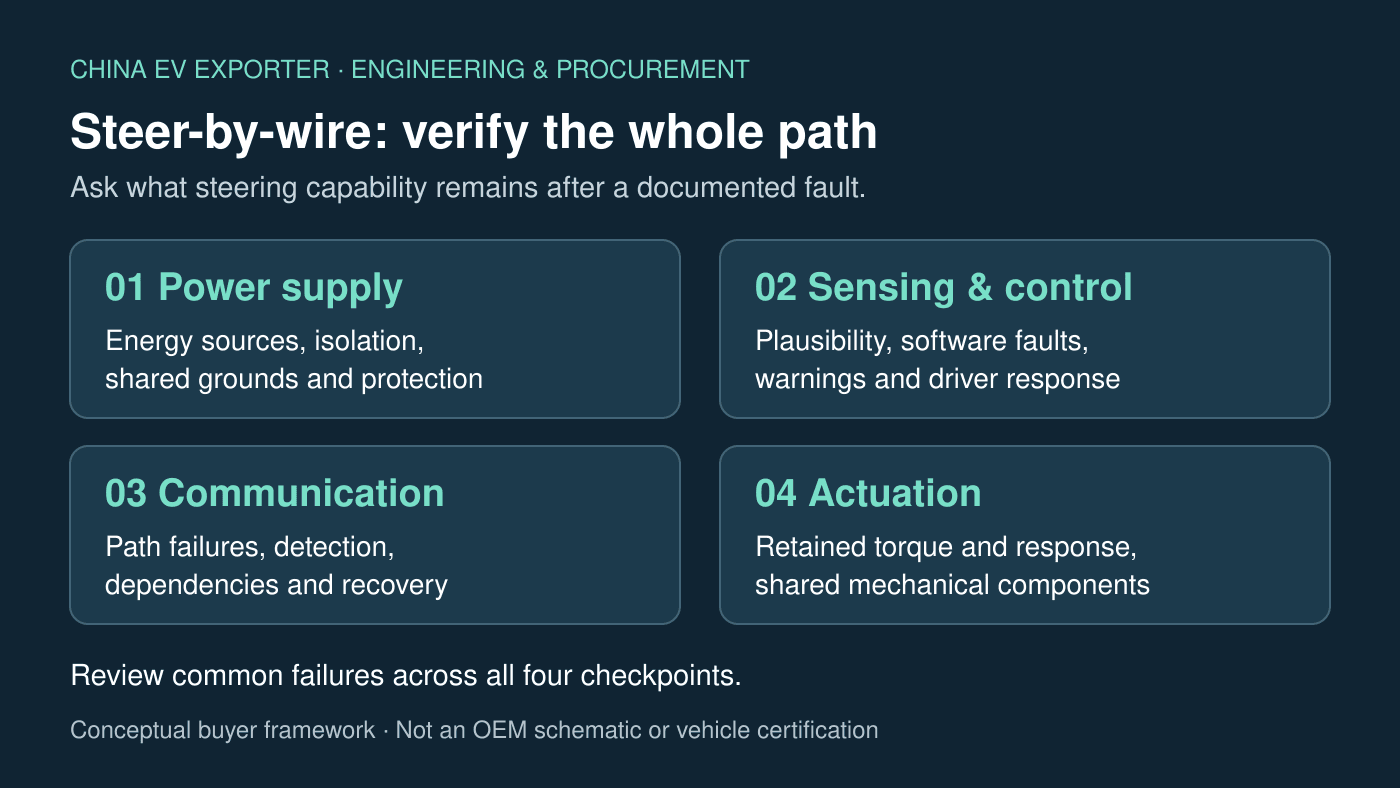
The cover diagram illustrates questions about power, control, and actuation. It is conceptual, not an OEM schematic or proof that a particular vehicle has two independent steering channels. For adjacent topics, see our engineering guides and procurement guides.
1. Executive Summary & Key Procurement Conclusions
- Separate China compliance from destination approval. GB 17675-2025 is a Chinese steering standard. A supplier must identify which rules and approval route apply to the destination; do not assume a domestic certificate grants global registration rights.
- Buy documented fault behavior, not a component count. Two controllers or two batteries can still share a connector, ground, software defect, or actuator failure. Ask how the design addresses those dependencies and what control remains after a fault.
- Make recovery support part of delivery. Obtain instructions for the exact model, including low-voltage failure and collision conditions. Do not improvise a towing or jump-start procedure from a generic steer-by-wire diagram.
- Prove repair access in the destination. The workshop needs the appropriate tools, permissions, manuals, and parts. A diagnostic connector or a subscription brochure does not demonstrate that a local technician can finish a steering repair.
- Compare quoted costs and downtime. Do not assign a universal insurance uplift to steer-by-wire. Obtain variant-specific premiums and landed repair prices, then compare scenarios using the same fleet assumptions.
2. Regulatory Architecture: China GB 17675-2025 vs. UN R79
The official Chinese catalogue records GB 17675-2025, Steering system of motor vehicles—Basic requirements, as published on December 2, 2025, with implementation on July 1, 2026. Those dates identify the standard; they do not prove that a named vehicle or export batch complies. Ask the manufacturer to map the applicable text, transition provisions, and vehicle configuration to its compliance dossier. Official SAMR/SAC standard record.
UN R79 concerns steering equipment. Ask the manufacturer or technical service for the applicable approval documentation, system overview, electronic-system safety assessment, and fault-response evidence. Have the destination approval specialist confirm how Annex 6 applies to the offered configuration. Annex 6 is not a standalone global vehicle-registration certificate. The cited 2025 publication is a reference snapshot: the applicable amendment series and transition provisions must be confirmed for the actual approval. UN R79 reference text on EUR-Lex.
For a global buyer, the useful comparison is the evidence required at each decision point. The following requests are our procurement framework, rather than a claim that every jurisdiction requires the same paperwork.
| Decision point | China-side evidence to request | Destination-side question | Purchasing consequence |
|---|---|---|---|
| Vehicle identity | Manufacturer, type, variant, and production window | Does the offered configuration match the approved one? | Hold an allocation with unresolved identity. |
| Standard version | Applicable GB 17675 edition and test references | Which steering rules and amendment series apply locally? | Obtain a written applicability assessment. |
| Steering architecture | Declaration of mechanical connection or backup | Is that architecture covered by the proposed route? | Reject “digital chassis” as sufficient evidence. |
| Electronic safety | Safety-concept summary and assessment references | What supporting technical evidence is required? | Arrange controlled review if records are confidential. |
| Fault performance | Test conditions and recorded residual capability | What vehicle-category requirements must be demonstrated? | Do not invent a generic speed or torque threshold. |
| Electrical dependencies | Power-distribution and shared-system information | Which common failures were considered? | Escalate unexplained shared dependencies. |
| Release configuration | Steering hardware and software identifiers | Do later changes need approval review or extension? | Match supplied vehicles to the accepted dossier. |
Ask the destination approval specialist to identify the responsible authority, accepted evidence, and remaining registration steps. UN steering approval, whole-vehicle approval, import permission, and individual registration answer different questions. Avoid treating the EU, UK, GCC, Australia, or other markets as one interchangeable approval regime.
3. Engineering Deep Dive: Four Layers of Redundancy Evidence
Conventional EPS usually assists a mechanically connected steering system. A pure steer-by-wire design instead needs an electrical safety concept for transmitting driver commands. “Fail-operational” should describe a defined retained function under stated faults and conditions; it should not be read as unlimited normal operation after any failure.
Layer 1: Electrical power and fault containment
Request a power-path diagram showing energy sources, converters, protection, distribution, grounds, and supplies to both sensing and actuation. A second low-voltage battery is one possible design choice, not a universal compliance prescription. Two supply wires do not by themselves demonstrate independent energy availability.
Ask the OEM to explain a short circuit as well as a disconnected supply: can one fault pull down another channel? What happens with low state of charge, cold batteries, or a traction-system shutdown? Request the tested duration and load conditions for any retained steering capability. Do not assume a fixed reserve time from the presence of a backup module.
Layer 2: Sensors and command plausibility
The handwheel input and road-wheel response need reliable measurement. Ask how the system detects a missing, stuck, or implausible signal and how it determines which information to trust. Sensor count alone is insufficient if channels share the same mounting, supply, or failure mechanism.
For fleet use, the practical deliverable is a comprehensible explanation of the resulting warnings and service restrictions. A buyer should be able to connect a dashboard message to the operator handbook and assistance procedure without interpreting raw engineering fault codes.
Layer 3: Controllers, communication, and software
Request the controller and network safety summary, including communication-loss detection, diagnostic coverage assumptions, and common-cause analysis. CAN-FD, Ethernet, or another network name describes a communication technology, not a complete safety case. Similarly, lockstep processing is a design technique rather than proof that two complete steering paths are independent.
ISO 26262 provides a functional-safety framework for automotive electrical and electronic systems. The linked record is specifically ISO 26262-1:2018, Part 1: Vocabulary; it does not certify a vehicle or establish a universal hardware layout. Ask the OEM what its safety claims cover, including system boundaries and integration evidence. ISO publication record and scope.
Layer 4: Actuation and mechanical dependencies
Ask what torque and steering response remain after the faults considered in the safety case. Separate an inverter fault from a motor fault and a mechanical jam: adding electrical channels does not automatically solve every shared mechanical failure. Request the tested operating envelope, including load, temperature, tires, and maneuver conditions.
A useful supplier answer names a document, configuration, fault, observed response, and acceptance criterion. “Dual redundant, therefore safe” leaves the core engineering question unanswered. Buyers should request witnessed evidence through the OEM or qualified technical service, rather than disconnecting batteries or cutting communication lines themselves.
4. State Machine & Degradation Response Matrix
Use this conceptual sequence to organize the review. Actual state transitions, warnings, and permitted actions must come from the vehicle documentation:
Normal steering operation
          |
    Fault detected
          |
Documented degraded response
          |
Follow model-specific warning
          |
Approved stop / recovery / service
The matrix below is a set of questions for the OEM. It does not prescribe a safe driving speed, guaranteed reserve duration, or automatic emergency maneuver.
| Fault scenario | Evidence to request | Operator question |
|---|---|---|
| Primary supply unavailable | Fault-isolation test and retained-energy conditions | What warning appears and what action is required? |
| Communication path lost | Detection, alternate-path behavior, and timeout evidence | Does the handbook require stopping? |
| Steering-input disagreement | Plausibility logic and validated reaction | How is an unreliable input communicated? |
| Road-wheel position disagreement | Detection and resulting control strategy | What service or recovery restrictions apply? |
| Actuator-channel fault | Residual capability at the specified load | Is continued movement permitted, and under what conditions? |
| Handwheel feedback fault | Input sensing versus feedback availability | How should the driver respond to changed steering feel? |
| Multiple faults or depleted reserve | Safety-case boundaries and emergency instructions | Which assistance procedure applies? |
Do not infer automatic lane pull-over from steer-by-wire capability. Such a maneuver requires additional vehicle functions and evidence. Also distinguish a workshop reset that clears a warning from proof that the original fault has been repaired.
5. Emergency Recovery, Towing, and Workshop Handling Protocols
For a system without mechanical backup, an unpowered handwheel cannot be assumed to steer the road wheels. However, steering architecture alone does not establish every towing restriction. Drivetrain, brakes, parking mechanisms, collision damage, and vehicle-specific transport modes also affect recovery.
Before delivery, obtain a recovery pack in the languages used by local operators. It should identify approved lifting and attachment points, transport arrangements, parking-brake and neutral procedures, and instructions for unavailable low-voltage power. Where external power is permitted, the OEM instructions must specify the connection points and equipment. A generic voltage or current value from another vehicle is not a substitute.
Ask the roadside-assistance partner to review the pack and confirm that suitable equipment is available. Agree how damaged or immovable wheels will be handled and who can authorize the work. Do not assume that a mechanical rack-release pin, parking-brake release tool, or hidden tow-mode switch exists.
The purchasing deliverable is an accepted recovery procedure and named local support contact. During an actual breakdown, operators should follow that procedure and vehicle warnings. The importer should not turn an engineering diagram into instructions to force the wheels, bypass controls, or energize a damaged vehicle.
6. Workshop Servicing, Collision Repair, and DoIP Diagnostics
Destination support needs a practical demonstration, not just a promise of “OBD access.” Ask an authorized workshop to show that it can identify the supplied variant, read relevant faults, access current service information, and complete the OEM-specified steering service workflow using its destination-market account.
Diagnostic over IP (DoIP) may be part of the toolchain, and some systems use security-gateway authentication. Neither is a universal requirement inferred merely from the term steer-by-wire. Confirm the actual interface, software license, account permissions, network availability, renewal costs, and escalation process for the selected vehicle.
Mechanical alignment, centering, sensor learning, and post-repair validation must follow the model's current repair information. Do not prescribe a universal rack-locking pin, calibration tolerance, or diagnostic routine identifier. Different repairs can require different checks; a tie-rod replacement and a complete actuator replacement should not be assumed to use the same workflow.
Request a sample repair record containing the part number, labor operations, required calibrations, software identifiers, and release criteria. Ask who pays if a license expires or a cloud service becomes unavailable during a warranty repair. Record how replacement modules are commissioned and whether shipping or remote authorization creates a delay.
If these support conditions are unresolved, send the variant, destination, fleet size, and workshop-access questions to China EV Exporter. This information helps define a sourcing inquiry; supplier documents and local approval review remain necessary.
7. Model Screening: Separate Marketing Claims from Steering Evidence
A platform name or an impressive turning demonstration cannot identify the steering equipment fitted to an offered vehicle. Rear-wheel steering can coexist with a conventional front steering connection. Torque vectoring and active suspension answer different engineering questions. Model names can also span multiple years and trims.
Use this table when reviewing supplier listings, rather than treating it as a verified model-availability benchmark. No row establishes current export availability, steering hardware, or homologation status.
| Supplier claim or listing | Clarification to request | Evidence needed before classification |
|---|---|---|
| Nio ET9 offered as steer-by-wire | Which model year, market specification, and software release? | OEM steering description and matching approval references. |
| IM L6 or LS6 with a “digital chassis” | Is the claim about front steering, rear steering, or chassis coordination? | Configuration-specific steering-system declaration. |
| Zeekr 001 or 7X on a shared platform | Does this exact variant retain a mechanical front steering link? | Variant equipment record and steering documentation. |
| Xiaomi SU7 with “smart steering” | What does the term mean for the offered trim? | OEM technical information identifying the transmission of steering commands. |
| Yangwang U9 or Denza Z9 GT turning demonstration | Is the maneuver produced by wheel torque, steering actuation, or both? | Separate descriptions of steering, drive, and suspension functions. |
| Any vehicle advertised as “by-wire ready” | Is the function fitted, enabled, supported, and approved in this shipment? | Production configuration, software status, and destination applicability review. |
Maintain one evidence sheet per offered variant. Record the supplier's statement, document identifier, date, reviewer, unresolved issue, and purchase consequence. Mark missing information as unknown; do not promote a platform capability or future announcement into a production specification.
8. Fleet TCO & Insurance Underwriting Sensitivity
There is no defensible universal steer-by-wire rack price or insurance surcharge in the sources reviewed here. Obtain written parts, labor, recovery, and insurance quotations for the actual destination and variant. Ask whether an actuator can be repaired, exchanged, or only replaced under the OEM procedure; do not assume a universal sealed-unit policy.
Thatcham Research's Vehicle Risk Rating considers damage, repair, safety, security, and performance. That framework supports asking about repairability, but its public overview does not establish a fixed steer-by-wire rating penalty or premium increase. Thatcham Vehicle Risk Rating.
Worked downtime example — hypothetical inputs, not market data
Suppose a buyer compares two support packages for a 100-vehicle fleet. Assume two steering repairs per year, each requiring five workshop days after the part arrives. Package A has an assumed 20-day parts delay; Package B has five days. Assign a hypothetical $60 per unavailable vehicle-day, representing replacement transport or lost contribution, counted once.
| Calculation | Package A | Package B |
|---|---|---|
| Fleet size, for context | 100 vehicles | 100 vehicles |
| Assumed annual steering repairs | 2 | 2 |
| Assumed parts wait per repair | 20 days | 5 days |
| Assumed workshop time per repair | 5 days | 5 days |
| Total unavailable days per repair | 25 days | 10 days |
| Annual unavailable vehicle-days | 2 × 25 = 50 | 2 × 10 = 20 |
| Annual downtime cost at $60/day | $3,000 | $1,200 |
The illustrative annual difference is $1,800. That is the modeled downtime benefit of the faster package under these assumptions, before comparing its price. The two assumed repairs are not an observed failure rate or an industry benchmark. Repeat the arithmetic with your own event counts, local labor availability, and quoted lead times.
Add actual parts and labor costs, recovery charges, diagnostic subscriptions, freight, duties, and insurance premiums to the comparison. Credit warranty reimbursement only where contract terms support it. Avoid counting both rental cost and lost revenue for the same loss without explaining the relationship. A faster dispatch promise also needs a realistic allowance for customs, delivery, scheduling, and calibration.
9. Five-Gate Importer Procurement Checklist
Use these gates as proposed commercial acceptance conditions. They are not universal statutory requirements; adapt them with the supplier and destination specialists.
- Gate 1 — Identity and approval: Match manufacturer, variant, production window, steering configuration, and relevant software to the dossier. Obtain the destination applicability assessment and references to accepted approval evidence. Hold shipment if the supplied specification differs.
- Gate 2 — Safety evidence: Obtain an understandable safety-concept summary and access to supporting assessment evidence. Record fault coverage, dependencies, retained function, and limits. Have qualified specialists resolve technical gaps instead of improvising fault tests.
- Gate 3 — Workshop readiness: Confirm manuals, tooling, licenses, destination account access, technician preparation, and a representative service demonstration. Assign an owner for renewals and support escalation before the fleet enters service.
- Gate 4 — Recovery readiness: Obtain the exact model's recovery instructions, translated where needed. Secure acceptance from the roadside-assistance provider and verify equipment availability. Document who handles unpowered and collision-damaged vehicles.
- Gate 5 — Parts and cost coverage: List steering component part numbers, landed prices, warranty conditions, dispatch commitments, and replenishment terms. Size local stock from fleet exposure, lead time, and acceptable downtime rather than a generic percentage.
Convert each open gate into a contract schedule with a deliverable, responsible party, due date, acceptance method, and remedy. Distinguish a dispatch deadline from arrival at the workshop and from return to service. For confidential safety documents, agree a controlled review route and a written acceptance record rather than promising unrestricted access that the supplier cannot provide.
FAQ
What is the difference between steer-by-wire and conventional EPS?
Conventional EPS normally adds electric assistance to a mechanical steering connection. In a pure steer-by-wire system, electronic sensing and actuation transmit the driver's command without that continuous mechanical link. Confirm whether the specific system has mechanical backup; a marketing label alone is insufficient.
When did GB 17675-2025 take effect?
The official Chinese standard record lists July 1, 2026, as its implementation date. The record identifies the standard but does not certify an individual vehicle. Ask the manufacturer to explain applicability and compliance for the offered variant and production batch.
Does China compliance automatically permit registration overseas?
No. Identify the destination's approval and registration route. Where UN R79 evidence is relevant, confirm its applicability, amendment series, and configuration coverage with the responsible specialist. Do not treat Annex 6 assessment evidence as a complete whole-vehicle registration dossier.
What happens if the low-voltage supply fails while driving?
The response depends on the vehicle's documented architecture, fault conditions, and remaining energy. Ask for validated retained capability and driver instructions. Do not assume a second battery guarantees full steering indefinitely or that steer-by-wire automatically provides an autonomous safe stop.
Can an unpowered steer-by-wire EV be towed with a rope?
Do not assume this is permitted. Follow the exact vehicle's recovery instructions and use qualified assistance. Steering availability, drivetrain limits, brake state, and collision damage affect the procedure. This guide does not authorize rope towing or provide a generic jump-start method.
Does every steer-by-wire repair require DoIP calibration?
No universal workflow can be inferred from the steering label. Obtain the model's service instructions and confirm required tools, permissions, alignment operations, and calibration steps. Demonstrate that the destination workshop can complete the relevant repair with authorized access.
How much more will steer-by-wire insurance cost?
There is no fixed uplift established here. Request an insurer quotation for the exact vehicle and fleet use. Compare repair prices, support access, recovery arrangements, and downtime using documented inputs; the worked example above models downtime only.
What should fleet buyers put into the purchase contract?
Include configuration identity, destination approval deliverables, safety-evidence review, workshop access, recovery documentation, and parts support. Define acceptance criteria, deadlines, and remedies. Specify who pays for tooling, subscriptions, freight, and vehicles waiting for warranty repairs.
Prepare a Steer-by-Wire Fleet Inquiry
Send the destination country, model year and trim, fleet quantity, intended use, and required delivery window. Include any supplier claims or approval references already received, plus your workshop and recovery arrangements. Request a vehicle sourcing and documentation discussion with China EV Exporter to identify what the supplier still needs to confirm before you commit.
Sources & Authoritative References
Sources reviewed November 3, 2026. These references support the statements identified in the text, not the hypothetical costs or any model-specific certification claim.
- SAMR/SAC — GB 17675-2025, Steering system of motor vehicles—Basic requirements. Official catalogue record supporting the standard identity, publication date, and implementation date. The catalogue is not a substitute for reviewing the applicable full text. Official standard record.
- UNECE — UN Regulation No. 79, published in the EU Official Journal as 2025/3. Reference for steering approval documentation and electronic-system safety assessment. This 2025 text is not asserted to be the latest applicable series for every destination; confirm current status for the approval concerned. Access limitation checked November 5, 2026: EUR-Lex presented browser verification at both its CELEX and Official Journal HTML entrances. The full text and individual paragraph references were not independently rechecked; confirm them in the applicable official text with the approval specialist. Official Journal text on EUR-Lex.
- ISO — ISO 26262-1:2018, Road vehicles — Functional safety — Part 1: Vocabulary. Public scope and publication record for the vocabulary part of the functional-safety series. It is not a vehicle certificate, a complete parts 1–12 assessment, or a SOTIF reference. ISO publication record.
- Thatcham Research — Vehicle Risk Rating. Public overview of the rating framework and its repairability context. It does not substantiate model-specific steering prices, fixed rating changes, or fleet premium estimates. Vehicle Risk Rating overview.
الكاتب

التصنيفات
مقالات أخرى
China EV Export Update W28: UK GBTA, Brazil Tariff, Suez
China EV export market update for 2026-W28: UK GBTA, Brazil 35% CBU tariff, Suez surcharges, Australia carry-forward, and Q3 shipment actions for importers.
800V Architecture in Chinese EVs: Charging Infrastructure Compatibility and Procurement Guide
Use this engineering and procurement guide to 800V Chinese EVs to evaluate charging compatibility, depot upgrade costs, and sourcing risks.

Brake-by-Wire in Chinese EVs: One-Box EHB, Dry EMB, GB 21670-2025, and UN R13-H Homologation Procurement Guide
Compare Chinese EV brake-by-wire, One-Box EHB and dry EMB. Check GB 21670-2025, UN R13-H evidence and workshop readiness before requesting a vehicle RFQ.