

Air Suspension and Continuous Damping Control (CDC) in Chinese Export EVs: Closed vs. Open Pneumatic Architectures, Extreme Climate Durability, Workshop Height Calibration, and Fleet TCO Procurement Guide
Compare Chinese EV air suspension and CDC: open vs closed circuits, climate evidence, height calibration and fleet TCO. Prepare your procurement checklist.
Quick procurement answer: Buy Chinese EV air suspension and Continuous Damping Control (CDC) against a documented vehicle specification, a destination workshop demonstration, and a priced support plan. A closed pneumatic circuit recovers gas during normal height changes; it does not, by itself, prove nitrogen filling, freedom from contamination, or better fleet reliability. CDC varies damper behavior and is a separate specification from air springs. Neither feature label establishes local repair access.
For automotive distributors, fleet technical directors, and workshop managers, the release decision is practical: can the exact supplied variant meet the route requirements, and can a local technician return it to service after a suspension repair? Send your vehicle shortlist, destination and workshop requirements to China EV Exporter to prepare a documented sourcing request.
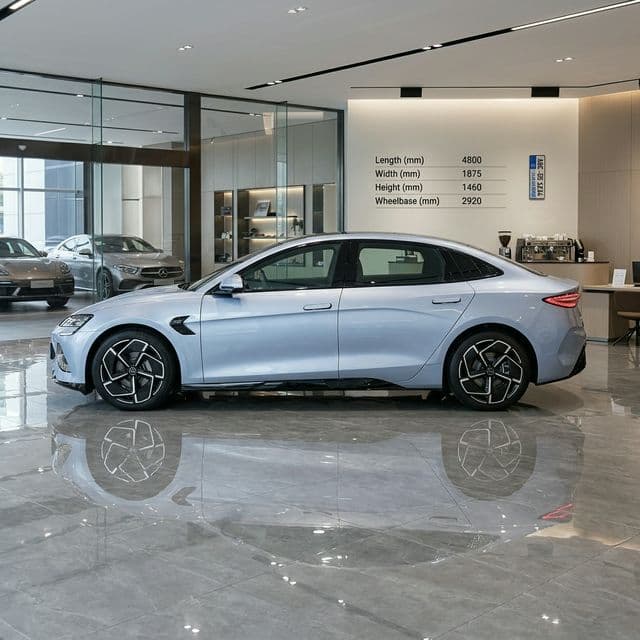
Published and reviewed: November 13, 2026. Scope: Global B2B screening of China-manufactured passenger EVs and premium MPVs. Equipment, approval requirements and service procedures depend on model year, trim, VIN, destination and software version. The cover is a vehicle illustration, not evidence of its suspension equipment.
Method and boundaries: This is desk-based procurement guidance, not a physical durability test or a vehicle service manual. The sources below explain pneumatic architecture, variable damping and a historical lighting regulation. They do not verify the equipment or failure rates of any named Chinese model. The comparison questions, acceptance checklist and cost scenario are editorial decision aids. Obtain VIN-specific OEM documents and destination approval advice before committing a fleet order; use current workshop instructions for actual repairs.
1. Executive Summary: Five Procurement Conclusions
- Separate the three specifications. Record pneumatic circuit topology, spring chamber arrangement and damper technology independently. A dual-chamber spring does not prove a closed circuit, and a car with CDC can use steel springs.
- Demand evidence for the actual export variant. A supplier logo or a domestic launch brochure does not identify the installed compressor, gas specification, diagnostic access rights or destination warranty. Tie each response to the production configuration on the quotation.
- Qualify the operating environment. Request hot-soak, cold-soak, dust and moisture validation with test conditions and acceptance criteria. A broad claim such as “desert ready” cannot establish performance on your route.
- Demonstrate the complete repair workflow. Reading fault codes is insufficient evidence of height-calibration access. Ask the destination workshop to demonstrate the authorized procedure on a representative vehicle before volume delivery.
- Compare cost and availability together. Include acquisition premium, labor, tooling, software access, parts logistics and downtime. Low parts prices provide little protection when a vehicle waits weeks for an approved replacement.
These gates favor different choices for different buyers. A chauffeur fleet may justify a comfort premium where service support is established. An operator on remote routes may prefer a simpler suspension package when predictable repair access matters more than selectable ride height. Record the service assumption behind the choice rather than treating the highest equipment grade as automatically best.
2. Open vs. Closed Pneumatic Architectures
An open air-supply system normally releases gas to the atmosphere when lowering. A closed system recovers gas into a reservoir for reuse. Continental's original patent application US20210178847A1, description of open and closed air-supply operation explains this distinction and also describes atmospheric filling of a system that can operate in closed mode. “Closed” therefore describes an operating arrangement, not necessarily permanent isolation from outside air.
Gas specification is a separate question. Do not infer a nitrogen-only charge, a universal reservoir pressure, or a particular refill method from the word “closed.” Request the pneumatic diagram and the OEM filling procedure. If the specified service medium is nitrogen, require its stated purity, dryness, charging equipment and handling procedure. If atmospheric make-up is possible, identify the intake and dryer provisions.
Use this matrix to compare two actual quotations. The final column defines the evidence needed; it is not a claim that any current model has passed.
| Procurement item | Open-system question | Closed-system question | Evidence to request |
|---|---|---|---|
| Normal lowering path | Where does exhausted gas leave? | How is gas returned to storage? | Pneumatic schematic and operating description |
| Make-up gas | How is incoming air filtered and dried? | When can outside air enter, if at all? | Intake, dryer and replenishment instructions |
| Working pressure | What are component limits and control targets? | What are reservoir and spring limits? | OEM specifications with gauge/absolute pressure identified |
| Height-change performance | What is measured at the specified load? | What is measured under the same conditions? | Timed test with temperature, load and starting height |
| Thermal behavior | What are cycle limits and recovery rules? | What are cycle limits during gas transfer? | Compressor limits and vehicle validation report |
| Loss of pressure | What functions remain after a leak? | What recovery or charging procedure is permitted? | Fault-response and recovery instructions |
| Workshop service | What dryer, filter or line service is required? | What gas-handling equipment is required? | Current workshop procedure and equipment list |
| Parts and support | Which assembly and software versions fit? | Which assembly and software versions fit? | VIN-linked parts catalogue and support agreement |
A reservoir or a compressor photograph is not enough to classify the system. Ask whether the drawing represents normal operation, emergency replenishment or workshop filling. Record unresolved questions as “unconfirmed” on the purchase comparison. Do not convert missing documentation into a favorable assumption.
Visual: gas flow and procurement boundaries
Conceptual diagram prepared for this guide; not a model-specific repair schematic. The text and comparison table provide the same information without relying on the image.
3. Single-Chamber, Dual-Chamber and CDC Selection
Air springs support the vehicle through compressed gas. Changing the gas quantity can adjust height and accommodate load within the system's approved range. A switchable auxiliary chamber changes the effective gas volume available to the spring. With other conditions held equal, a larger effective volume generally gives a softer pneumatic spring contribution; isolating that volume can make it firmer. Real behavior also depends on pressure, geometry, travel and the control strategy.
This does not establish a universal stiffness increase, response time or handling improvement. Ask the OEM which axles have switchable chambers, when switching occurs, and what restrictions apply at different speeds or loads. A single-chamber system is not inherently unsuitable for fleet work. Judge passenger comfort and body control with the expected payload and route, including rear-seat occupancy and luggage.
CDC concerns damping rather than gas volume. ZF's CDC technical overview describes sensor-informed, wheel-specific adjustment of compression and rebound damping through a valve system. That is technical background, not evidence that ZF supplies a particular Chinese export model. Semi-active variable dampers regulate motion; they should not be described as a fully active suspension capable of commanding arbitrary body forces.
For procurement, request the installed damper part numbers, electrical compatibility and behavior following a control fault. Road preview is another configuration item: determine whether the quoted vehicle actually has it, which sensors it uses, and whether the function remains available with destination software. Do not assume that a camera or LiDAR fitted for driver assistance also supplies suspension preview.
Compare a steel-spring vehicle with variable dampers where that option exists. It may provide useful ride tuning without the pneumatic service requirements. Assess the complete package rather than comparing a well-equipped air-suspension trim against a poorly matched base vehicle and attributing every difference to the springs.
4. Extreme Climate Durability: Ask for Conditions, Not Labels
Climate qualification should start with the fleet's operating envelope: ambient temperature range, parking exposure, humidity, dust, road roughness, passenger load and frequency of height adjustment. These are inputs to validation, not evidence that a vehicle will fail at a particular temperature. No fleet failure dataset accompanies this guide.
Desert heat and dust
For GCC or other hot, dusty routes, ask for vehicle-level hot-soak and repeated height-change results at the intended load. The report should identify starting conditions, cycle sequence, compressor protection behavior and recovery time. A component temperature rating alone does not establish performance when installed behind underbody shielding with limited cooling.
Inspect intake routing, filter serviceability, bellows protection and connector sealing against the OEM design. Airborne dirt can affect pneumatic intake components, while external grit can affect exposed moving parts on either circuit type. A closed operating mode does not protect every external surface or eliminate contamination introduced during a repair. Avoid specifying improvised sealed covers that could interfere with movement, drainage or cooling.
Humidity, water and coastal exposure
Request the permitted water exposure, corrosion validation and maintenance requirements for the complete assembly. Ask how the dryer is regenerated or serviced where fitted, how water is excluded during workshop work, and how leaks are diagnosed. Do not treat an ingress rating on one electrical connector as a rating for the compressor, reservoir and air spring together.
Record flood exclusions, washing restrictions and warranty limits in the service agreement. Operators should know which exposure requires inspection before a vehicle returns to service. A supplier's generic “waterproof” description is not a usable maintenance instruction.
Cold weather and rough roads
For severe winters, request cold-soak height-adjustment and ride results at the intended load, together with the permitted operating range. Elastomer properties and damper-fluid behavior vary by material and design; there is no universal rubber failure temperature that approves or rejects every air spring.
On rough roads, evaluate usable travel, underbody clearance and allowable speeds in each height mode. Maximum parked clearance may not be an approved continuous driving setting. Request confirmation that a loaded vehicle can complete the route without repeated suspension warnings, and define how pilot observations will be recorded before expanding the order.
Ask China EV Exporter to include these climate and service evidence requests in your supplier RFQ. A test report tied to the quoted configuration is more useful than a general assurance about an entire brand.
5. Homologation and Ride-Height Changes
Ride height affects vehicle attitude and can affect headlamp aim and dynamic behavior. Procurement should therefore verify the destination-approved configuration, including permitted height modes, wheel and tire sizes, lighting equipment and relevant braking/stability approvals. Domestic sale approval does not by itself establish destination registration eligibility.
UN Regulation No. 48, historical EUR-Lex publication is a reference for lighting installation and levelling requirements. It is not a current approval determination for your vehicle. Applicable amendments, lamp characteristics, vehicle category and destination adoption must be checked by the approval specialist. Do not apply a single beam angle or lumen threshold as a universal acceptance rule.
Likewise, a suspension feature name does not demonstrate the relevant braking or stability approval. Ask the importer or technical service which documents cover the actual variant and software. Do not infer that every vehicle must use a particular sensor network or control algorithm to comply.
After a repair, the workshop must check whether the OEM procedure calls for headlamp aiming, wheel alignment or additional sensor calibration. A suspension height relearn does not automatically complete those separate tasks. Retain the required verification records with the repair order.
6. Workshop Height Calibration and Gas Servicing
The following is a workshop-readiness acceptance sequence, not instructions for opening or charging a pressurized suspension. Actual depressurization, support, jacking, filling and calibration must follow the current OEM procedure for the specific vehicle. Stored pressure and automatic height movement require the prescribed isolation and support measures.
Five steps to demonstrate before fleet delivery
- Confirm the service prerequisites. Identify the manual revision, required tools, vehicle support arrangement, loading condition, tire pressures and measurement surface. Do not assume every OEM requires a full battery, the same rack tolerance or the same measurement datum.
- Prove authorized diagnostic access. Record the tool version, subscription, account region and permissions. Show that it can perform the required chassis operation, rather than merely read generic fault codes. Where a secure gateway applies, obtain legitimate access and renewal terms.
- Demonstrate the measurement and calibration workflow. Use the OEM reference points and units, then perform the guided routine. Diagnostic transport and routine identifiers depend on the platform; DoIP support alone does not establish calibration capability.
- Record the outcome. Retain before/after measurements, relevant fault records and the procedure's success result. Complete the required settling or verification sequence and investigate any corner that remains outside the specified tolerance.
- Complete related checks. Perform any required leak checks, alignment, headlamp aiming and other calibrations, followed by the prescribed functional assessment. Agree who signs the vehicle back into fleet service.
Cybersecurity approval requirements do not, by themselves, prescribe a universal workshop token or diagnostic transport. Avoid buying a tool solely on a claim that it supports the brand. Require a demonstration with the actual model and intended operation, and confirm whether the authorization remains usable outside China.
Closed-system gas servicing
Obtain the OEM's permitted medium, pressure definition, fill sequence, connection type and equipment specification before purchasing a charging rig. A universal nitrogen pressure, Schrader adapter or vacuum evacuation method cannot be prescribed across brands. Some systems may have onboard replenishment; others may require an external charge after certain repairs. Do not improvise with shop air or substitute a gas because another model uses it.
Use symptom-based triage to specify workshop capability. The table gives investigation questions, not universal fault-code definitions or permission to replace a component without diagnosis.
| Symptom | Possible areas to investigate | Evidence the workshop should capture |
|---|---|---|
| One corner lowers while parked | Spring, fitting, line or valve leakage | Height observations and OEM-approved leak-check results |
| Height change stops when hot | Protection state, electrical supply, leak or duty demand | Fault records, relevant live data and operating conditions |
| Harsh or poorly controlled ride | Tires, mechanical damage, damper control or calibration | Physical inspection and vehicle-specific diagnostic results |
| Vehicle leans after a repair | Sensor linkage, measurement or stored calibration | Reference-point measurements and guided routine outcome |
| Headlamp aim changes | Vehicle attitude, levelling inputs or lamp adjustment | Required suspension and lighting verification records |
| System cannot restore height | Pressure supply, distribution, leak or control fault | OEM fault-tree checks and approved recovery decision |
Part selection must follow the VIN and approved supersessions. Shared supplier branding does not prove interchangeability: mounting geometry, gas connections, electrical characteristics and software compatibility may differ. Record return rights and warranty handling before stocking an expensive assembly.
7. Fleet TCO: A Reproducible Budget Scenario
There is no universal air-spring replacement mileage or overseas savings percentage established by the sources here. Use supplier quotes and pilot records to build a service budget, then test how it changes with parts consumption and vehicle availability.
The following hypothetical scenario covers suspension-related service and downtime for 50 vehicles over three years and 120,000 km per vehicle. All quantities and prices are assumptions, not observed failure rates, market quotations or a forecast for any brand. The steel-spring and air-plus-CDC columns are scenario packages; the result cannot isolate the cost of pneumatic springs from variable damping.
| Cost item and assumed calculation | Steel-spring package | Air suspension plus CDC package |
|---|---|---|
| Scheduled inspections: fleet allowance | $4,500 | $9,000 |
| Spring/damper repairs: 3 × $2,000 / 22 × $1,750 | $6,000 | $38,500 |
| Compressor/valve repairs: 0 / 14 × $1,000 | $0 | $14,000 |
| Diagnostic access and calibration: fleet allowance | $3,000 | $11,500 |
| Dedicated tooling allocation: fleet allowance | $0 | $6,500 |
| Downtime: 30 / 180 vehicle-days × $150 | $4,500 | $27,000 |
| Total scenario service and downtime cost | $18,000 | $106,500 |
| Per vehicle: total ÷ 50 | $360 | $2,130 |
The assumed difference is $88,500 across the fleet, or $1,770 per vehicle. This is a service-budget difference, not full vehicle TCO: it excludes acquisition premium, energy, insurance, financing, tax, residual value and revenue differences. Repair line items should include the agreed parts, labor and logistics scope; avoid charging the same labor again under calibration.
Sensitivity check: Fifty fewer downtime days would reduce the air-package scenario by $7,500 at the assumed $150 per day. A $500 change in the assumed cost of each of its 22 spring/damper repairs changes the fleet budget by $11,000. These calculations show why local parts availability and repair pricing deserve separate contractual attention.
For a comfort-led fleet, compare the extra cost with a defensible contribution margin from the service offered. At the assumed $1,770 difference, recovering that service difference alone would require $590 of additional net contribution per vehicle per year over three years. Acquisition premium and all excluded costs still need separate recovery. Do not count gross fare revenue as profit.
Spare-parts quantities should follow fleet size, replenishment lead time, repairability, pilot consumption and the required availability target. Bundling parts with a shipment may reduce some logistics costs, but obtain an actual landed quote, confirm shipping acceptance and preserve warranty eligibility. A fixed “four struts per ten vehicles” rule is not a substitute for that calculation.
8. Five-Gate Importer Procurement Checklist
Use this checklist as a purchase release record. Assign an owner and evidence attachment to each gate; treat an unanswered gate as pending rather than approved.
- Configuration gate: Record model year, trim, destination specification and VIN applicability. Attach the pneumatic schematic, gas/service specification, spring arrangement and damper part references.
- Environment gate: Attach relevant hot/cold, dust, water and corrosion evidence with test conditions. Record operating restrictions and agree a representative pilot route with the fleet operator.
- Approval gate: Confirm the destination registration pathway with the responsible specialist. Match the approval documents to the vehicle configuration and permitted suspension modes.
- Workshop gate: Demonstrate authorized diagnosis, required height calibration and related checks locally. Record tool costs, account renewal, required gas equipment and the approved recovery procedure.
- Support and economics gate: Price parts and labor, define warranty coverage, agree replenishment and reimbursement terms, and approve a service/downtime scenario using stated assumptions.
The purchase order should name the evidence owner, document version, acceptance event and remedy for an unresolved item. For example, the workshop gate can require a successful guided calibration demonstration on a representative vehicle before the volume release milestone. Agree commercial consequences explicitly; an informal promise of future software access leaves a material operating dependency unresolved.
Request a configuration, workshop-access and spare-parts sourcing review from China EV Exporter. Include fleet size, destination, climate, annual distance and local service capability so the response can address your actual constraints. For the surrounding sourcing process, use the China EV Exporter blog alongside this suspension-specific release checklist.
FAQ
Is closed-loop air suspension always filled with nitrogen?
No. Closed operation means that gas is recovered during normal height changes. Gas type, atmospheric make-up and repair charging requirements depend on the design. Obtain the OEM pneumatic diagram and service-medium specification before selecting workshop equipment.
Does CDC mean the vehicle has air suspension?
No. CDC describes variable damping. The springs may be pneumatic or mechanical, and chamber count is a separate specification. Check the quoted configuration rather than inferring the entire suspension package from a damping feature name.
Is a closed system automatically better for a desert fleet?
No. Recovery of gas may reduce atmospheric exchange, but thermal behavior, external protection, maintenance and local support still matter. Compare validation at the intended conditions and document the repair pathway before choosing either architecture.
Can an independent workshop calibrate ride height?
Potentially, if it has supported tools, authorized access, the correct procedure and required equipment for that variant. Code-reading capability or a generic DoIP claim is insufficient. Require a successful demonstration and confirm ongoing subscription and regional access terms.
What nitrogen pressure should a workshop use?
Use only the pressure and sequence specified by the current OEM service procedure, where nitrogen charging is required. Reservoir pressure, spring pressure and charging supply pressure are different quantities. This guide does not specify a universal charging value.
Must headlamps be checked after a height calibration?
Check the OEM procedure for the required lighting verification and any separate aiming routine. Height calibration does not prove that headlamp aim is correct. Destination approval requirements and the fitted lighting system determine the applicable compliance checks.
Can similar air struts be exchanged across Chinese brands?
Do not infer compatibility from appearance or a common component supplier. Match the VIN, approved part number and supersession, mounting, pneumatic connections, damper electronics and any coding requirements before ordering.
How should a fleet choose its initial spare-parts stock?
Combine replenishment lead time and expected consumption with the cost of vehicle downtime and your availability target. Begin with documented assumptions, revise them using pilot records, and confirm storage, shipping and warranty conditions. There is no universal stocking ratio established here.
Sources & Regulatory References
- Continental Teves, original patent application US20210178847A1: Method for operating an air suspension system, and air suspension system, published June 17, 2021. The description distinguishes open and closed operation and atmospheric replenishment. It is technical background, not proof of production fitment or durability on any Chinese EV.
- ZF: Continuous Damping Control product technical overview. Supports the explanation of sensor-informed variable damping; it does not establish a supplier relationship with a named vehicle in this guide.
- EUR-Lex / UNECE: UN Regulation No. 48, publication 2016/1723. Historical reference for lighting installation and levelling. Confirm the currently applicable amendment series and destination adoption with the approval specialist; the historical publication alone cannot approve a procurement decision.
الكاتب

التصنيفات
مقالات أخرى
800V Architecture in Chinese EVs: Charging Infrastructure Compatibility and Procurement Guide
Use this engineering and procurement guide to 800V Chinese EVs to evaluate charging compatibility, depot upgrade costs, and sourcing risks.
China EV Export Update W28: UK GBTA, Brazil Tariff, Suez
China EV export market update for 2026-W28: UK GBTA, Brazil 35% CBU tariff, Suez surcharges, Australia carry-forward, and Q3 shipment actions for importers.
China EV Export Market Update (2026-W28): EU Battery Label Deadline and UN R155 Aftermarket Diagnostic Wall
China EV export update (2026-W28): EU Battery Regulation Aug 18 label and QR code deadline, UN R155 secure gateway blocks independent repairers, and ongoing PHEV tariff risk.